The Lymington Society has put together an online questionnaire to assist with preparation for the forthcoming Neighbourhood Plan consultations to be carried out by Lymington and Pennington Town Council. Everyone in the Lymington and Pennington community is welcome to complete the questionnaire – it’s a great opportunity to put forward your thoughts and concerns on a range of planning issues faced in the local area.
Click to complete the Lymington Society Neighbourhood Plan online questionnaire
or alternatively, have your say by sending us a direct message.
Lymington Community Facilities and Services
Lymington is blessed with a large range of community facilities, some owned by the Town Council such as Woodside Park, Woodside Gardens and the Sea Water Baths and some run by the New Forest District Council (NFDC) such as the Recreation Centre. The town currently features most of the facilities and services that a prosperous small town might have.
What do you think? Do you think Lymington has a good range of facilities and services for all parts of society – including young people, older people, professionals and people with disabilities? Are cultural, retail, professional and social facilities and services sufficient?
If the Neighbourhood Plan is approved, more money should come to the Town Council from the Community Infrastructure Levy to be spent in the town and might be available for improved facilities. Do you think the Town Council should provide more facilities and services?
Have your say by completing the Lymington Society questionnaire!

Design and Climate Change
The design of new buildings and developments is extremely important in allowing new developments to take place in a way that does not conflict with existing buildings and the characteristics and distinctiveness of the area. This is especially true in an area such as Lymington, which is renowned for its Georgian architecture. At the same time, should we consider that some developments should reflect modern design rather than everything being a pastiche of the Georgian style?
Considering climate change and its possible effects on the design of new developments, should we insist that all new buildings have energy-saving features from the start, or wait until these methods have improved to the point where they are more economical? Should we be retaining existing buildings wherever possible, rather than creating carbon dioxide by knocking down and rebuilding perfectly useful buildings such as the old police station?
HAVE YOUR SAY BY COMPLETING THE LYMINGTON SOCIETY QUESTIONNAIRE!
Lymington and Pennington Housing
The NFDC Local Plan for the period up until 2036 calls for up to around 500 homes to be built in the Lymington and Pennington area with most being on so-called “strategic sites” approved in the Local Plan Part One adopted in July 2020. The sites are SS5, which is on either side of Milford Road near the entrance to the Efford Tip, and SS6, the land east of Lower Pennington Lane. Although nominally described as providing at least 285 dwellings, the current indication is that these sites will have significantly more than approved.
The Local Plan Part Two envisages another 200 homes being built on several smaller sites in the town and NFDC have called for owners of sites to put them forward for approval in Part Two of the Local Plan. The Town Council is likely to identify these sites and seek local approval for their inclusion in the forthcoming Neighbourhood Plan.
HAVE YOUR SAY BY COMPLETING THE LYMINGTON SOCIETY QUESTIONNAIRE!

Lymington Economy and Employment
Lymington is fortunate to have a low unemployment rate, with a retail centre more buoyant than in other towns across the country. The Ampress Industrial Estate has brought new businesses and facilities to the town without so far undermining the High Street as some feared.
Finding employees who can afford to live in the town can be a real headache for some businesses especially following the pandemic when many people left the workforce.
However, Ampress is almost reaching capacity and several employment sites are being earmarked for demolition and redevelopment for residential uses. Is this in the interest of the level of employment in the town, especially when taken alongside the conversion of shops and offices into flats? Should the Town Council use the Neighbourhood Plan to enable them to take steps to help boost the local economy?
HAVE YOUR SAY BY COMPLETING THE LYMINGTON SOCIETY QUESTIONNAIRE!
Lymington Infrastructure and Transport
Lymington’s location on the coast with the main road connection (A377) going through the New Forest National Park does impose travel constraints on the network into Lymington, especially when there is congestion through Lyndhurst, at the level crossing in Brockenhurst or if there are roadworks on either of the main roads into the town.
Increasingly traffic is being diverted across the open forest through Beaulieu or Ipsley onto the Marchwood bypass. This traffic includes large numbers of goods vehicles travelling on unsuitable roads with ponies and animals regularly being injured.
Whilst the town enjoys a good train service, the recent closure of the bus station has caused difficulties with new bus stops not being in ideal positions.
Many feel that a new travel hub adjacent to the railway station where people could catch buses, trains or taxis would be beneficial but space is limited at this location at the moment. Would the town benefit from an integrated travel plan, which could bring much better co-ordination of travel generally?
Concerns have been raised about the difficulty and danger of crossing the road at the bottom of the High Street, although Hampshire County Council (HCC) would suggest that the accident statistics don’t justify major changes or expense.
The quantity of parking available in the town is considered by some to be inadequate, especially if we are to increase the number of tourists coming to the town. Do we need more parking in the town or should we consider greener alternatives to reduce climate impacts?
HAVE YOUR SAY BY COMPLETING THE LYMINGTON SOCIETY QUESTIONNAIRE!

Lymington High Street and Town Quay
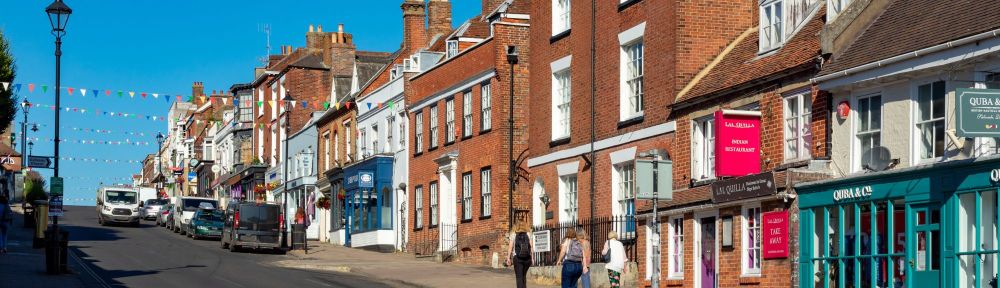
Both the Town Quay and the Georgian High Street are considered part of the special appeal of Lymington which draws visitors to the area. However, improvements or changes to the High Street and to the Town Quay suggested by residents and in the local paper on a regular basis and even by the Town Council more recently, have proved controversial.
Some people object to the loss of any parking in the town even when it takes up much of the “jewel in the crown” that is the Town Quay, whereas other people feel that having a huge car park and an ugly toilet block occupying this visitor area is a missed opportunity.
Changes to the High Street to create build-outs and wider pavements for cafés and planting have been suggested to create a continental feel to the town but inevitably this would lead to some loss of parking. Herringbone parking with a one-way street has also been suggested, which some think may have safety implications for cars when they pull out backwards.
Hopefully, a consensus can emerge, which will allow both these areas to be changed in a way that respects the Georgian heritage of the town but at the same time improve the attractions of both areas.
HAVE YOUR SAY BY COMPLETING THE LYMINGTON SOCIETY QUESTIONNAIRE!
Lymington’s Natural Environment
Lymington is fortunate to be surrounded by some of the most beautiful scenery and wildlife areas in the country. Much of the local area is protected by designations under nature protection measures either as the New Forest National Park or areas of outstanding natural beauty and conservation areas.
However, biodiversity is under threat right across the world with declining numbers of most animals and plants and many threatened with extinction. Pollution of the seas from plastics and from agricultural run-off causing toxic algae blooms to have caused the environment agency to implement restrictions on building due to nitrate release. Should we use the Neighbourhood Plan to bring about changes to the way that we manage our local natural spaces to increase biodiversity not only in our parks and hedgerows were also in our own gardens and public spaces in the town?
HAVE YOUR SAY BY COMPLETING THE LYMINGTON SOCIETY QUESTIONNAIRE!
or alternatively, have your say by sending us a direct message.
 The Lymington Society